Friday, 9 June 2017

Wyoming - Yellowstone Part 2

Our third day in Yellowstone continued to impress with panoramic scenery, more wildlife and huge geysers - smelly ones, colourful ones and the classic Old Faithful. There are MORE geysers in Yellowstone than anywhere else on earth which explains the never ending sight of steam and bubbles in the park. You never forget you are exploring an active volcano.

The National Parks Service website says....Sprinkled amid the hot springs are the rarest fountains of all, the geysers. What makes them rare and distinguishes them from hot springs is that somewhere, usually near the surface in the plumbing system of a geyser, there are one or more constrictions. Geysers are hot springs with constrictions in their plumbing (sounds painful), usually near the surface (ouch), that prevent water from circulating freely to the surface where heat would escape. The deepest circulating water can exceed the surface boiling point (199°F/93°C). Surrounding pressure also increases with depth, much as it does with depth in the ocean. Increased pressure exerted by the enormous weight of the overlying water prevents the water from boiling. As the water rises, steam forms. Bubbling upward, the steam expands as it nears the top of the water column. At a critical point, the confined bubbles actually lift the water above, causing the geyser to splash or overflow. This decreases pressure on the system, and violent boiling results. Tremendous amounts of steam force water out of the vent, and an eruption begins. Water is expelled faster than it can enter the geyser's plumbing system, and the heat and pressure gradually decrease. The eruption stops when the water reservoir is depleted or when the system cools.

The most famous geyser is Old Faithful which spurts every 90 minutes or so. Everyone sits around the edges on the long seats waiting for the old geyser to fire up, steam and spurt water upwards. It was overcast, cold and slightly drizzling so the colour show wasn’t that great. It would be amazing with a blue sky behind it. The photo doesn't do it justice but it's quite a show for about 20 seconds when it starts. And then, it's another 90 minutes until it does it again. This area is widespread with Geysers and while they can start to all the same, our GPS guide (Alan-Alan-Alan), tells us that each one is unique. And he's right. The size, the colour, the shape, they each have something to make you glad you stopped to see it. The surprising thing is that bison and some other animals hang around this area in winter as it's warm. They must know which ones are dangerous with sulphur and those that aren't. Or they aren't affected - I need to research this a bit more. But there's hoof-prints and bison crap amongst the geysers.


We explored the Grand Canyon in Yellowstone which was awesome. I can only imagine what the Grand Canyon in Utah looks like as this canyon was huge and cut a very high and steep groove in the mountains. The Yellowstone River was flowing strong and fast and the waterfalls were loud and powerful. There are so many places to stop and view the river, the canyon, the waterfalls and the landscape. Wow, it was just beautiful.


And we saw some more wildlife. We saw elk although their antlers were very small. Apparently they shed them each year and grow them back. These guys were fairly cool about people stopping to look and snap photos. The striking feature is their white bum.


Our Yellowstone adventure comes to a close but we now head into the Grand Tetons which are about 2 hours south of Yellowstone. This is another fantastic national park and we are keen to explore this albeit for only one day as we will eventually cross over into Idaho.


Wyoming - Yellowstone Part 1


My opening words about Yellowstone are DO IT !! I read in the travel book we have that seeing Yellowstone from the back of a cramped station wagon, or these days a decked-out Winnebago - is almost a rite of passage in this country.

Yellowstone is the US’ first National Park. Early expeditionists submitted a report to congress who granted the region National Park status in 1872 (under President Ulysses Grant). It is worth noting that President Theodore Roosevelt is considered the conservationist President as he established many national parks and established many more monuments. When you think National Parks in the US, you think Theodore Roosevelt.  

It is a nearly 3,500-sq.-mile wilderness recreation area atop a volcanic hot spot. Mostly in Wyoming, the park spreads into parts of Montana and Idaho too. Yellowstone features dramatic canyons, alpine rivers, lush forests, hot springs and gushing geysers, including its most famous, Old Faithful. It's also home to hundreds of animal species, including bears, wolves, bison, elk and antelope (thanks wiki).

Gypsy Guide. I must put a plug in for this fantastic app I loaded onto my phone. It’s called Gypsy Guide and cost $14 for Yellowstone and Grand Tetons. Once the application is loaded, it doesn’t use cell data when you're travelling, only your GPS which just sucks power so make sure you plug into power in the car. As you drive into the park and around it, the app tour guide talks along way. It (he, we call him Alan, Alan, Alan) knows when to talk because he knows your GPS location. The guide tells you information and suggests things to see along the way. It’s been fantastic. They do other locations so check out their website and I will definitely be using this again. https://gypsyguide.com

We stayed in West Yellowstone which was a great launch point to the park each day. There is daylight from about 6am to after 9pm each day so we easily packed in a long day. There are essentially two big loops like a figure 8 with major attractions in each loop and with heaps of other things to stop and see along the way. The scenery is just so gorgeous and the Yellowstone River is mighty, fast flowing and impressive with several beautiful canyons and falls. Being an active volcano, there are lots of hot springs to visit. They are boiling and bubbling and absolutely stink of sulphur smell (rotten egg smell). It was overpowering to say the least. You can’t touch the water, the ground or anything cause it will either burn you, melt you or kill you. Some of the springs have erupted over the years and I’m not sure I’d like to be there with that stuff being thrown at me. Some of them had beautiful colour due to the bacteria and algae.


The highlight so far has, of course, been the animals. The park is full of tourists in their cars, RVs, vans and Harley’s. We’re all here for the same thing and everyone is patient, courteous and soaking up the magnificent experience. You have to be very careful driving as the traffic can stop and jam at any moment due to an animal sighting - this is known as 'bear jam' or 'animal jam'. People scramble off the road or slow/stop as they drive by…so we all do the same like a slow moving train. I love it. It is a lot of fun actually. Deb has been the chief photographer and captured some great photos with the long lens. At one stop, I took a peak through another guy’s tele-photo lens at the fox photo and it was so close – wow, just incredible. We have the park map on our lap so we can cross check the animals that we see. Quite often cars pull up and say, what's here? They just stop regardless cause everyone else is stopped. At dinner at night or breakfast in the morning, the conversations are usually about what animals everyone has seen and more importantly, where they saw it cause you want to go there if you can.

There are lots of bison and they are bloody huge. They look quite messy with their winter coats falling off. We’d stopped to watch a bison right across the road and he decided to cross the road towards us. It was quite funny as I was at the car putting eye drops in so couldn’t see anything. But I could hear the ladies all saying, quick quick, get in the car and there were foot scuffles. I was trying to quickly blink the drops in so I could see what was happening. Then, Deb appears and I can see everyone scrambling into their cars as the bison is coming towards us. Talk about instant reverse and departure mode. He didn’t look harmful but you can’t be sure. I don't want to be explaining a bison dent to the car hire company!! Was such a funny scene though. There are about 5,500 Bison in Yellowstone, they weigh about 2000 pounds for males, 1000 pounds for females. Yellowstone is the only place in the lower 48 states to have a continuously free-ranging bison population since prehistoric times. In the 1800s, market hunting, sport hunting, and the US Army nearly caused the extinction of the bison. By 1902, poachers reduced Yellowstone’s small herd to about two dozen animals. The US Army, who administered Yellowstone then, protected these bison from further poaching.


The golden highlight was seeing some black bears. Firstly a young bear on his own and then later, a massive crowd was forming roadside with a ranger (holding a big can of bear spray) to view a mother and her two cubs in the distance. 

We also saw a fox sleeking through the bushes and then a coyote stalking some bison. I could only catch him as he was moving away but it was amazing to see him. The feeling of seeing these wild animals in their natural habitat is a bit like finding presents on Xmas morning from Santa when you were five years old. Very exciting feeling indeed. 


Anyway, here are some animal photos below to give you an idea.


Coyote running away
Fox having a rest 
Elk
Big Horn Sheep
Fox on the Run (sounds like a good band name!!)
The Batman

Cody. Before entering Yellowstone, we drove down from Billings in Montana through Cody. Here we visited the Buffalo Bill Centre of the West. I'm a bit young to remember Buffalo Bill and his theatre and shows but I've heard of him. This is a Smithsonian museum and was quite huge. It has five museums inside - Buffalo Bill museum, Plains Indian museum, Cody Firearms museum, Western Art museum and the Draper museum of Natural History. We spent most time in the Buffalo Bill and Plains Indian museums as our good friend recommended the Indian museum. It was worth the visit and I have to admit that I find the Indian history and culture very interesting. Buffalo Bill material was interesting but bit before my time. I did enjoy the firearms museum - I've never seen so many guns, rifles and pistols. It was an extensive collection from flintlocks to Glocks to Gatlings. The is the US I suppose. 


It's late as I write this and there is much more I could write but my pillow calls me. The Yellowstone adventure is to be continued...


Wyoming

We crossed the corners of Wyoming through the entire roadtrip except for Yellowstone where we spent three days. The north east corner of Wyoming has two key attractions. The Little Bighorn Battlefield and Devil’s Tower.


Devils Tower stands out like ‘dog’s balls’ (as a good Aussie would say). You can see it for miles, it stands big and tall on the landscape.  Another President Theodore Roosevelt legacy, he proclaimed Devils Tower the first national monument under his new Antiquities Act. Wyoming was now the home of the first national park (Yellowstone) and national monument. I sucked at geology in high school but the short story is that about 50 million years ago, molten magma was forced into sedimentary rocks above it and cooled underground As it cooled, it contracted and fractured into columns. Over millions of years, erosion of the sedimentary rock exposed Devils Tower. The tower is 867 feet (264m) high and the area on top is 1.5 acres. It's pretty huge basically. We walked the trail around the tower and you see the different rock formations in the rock. Rock climbers take to like bees to honey and this is a sacred site to Indians who often have ceremonies at the tower. 

Several Indian tribes tell a similar legend as follows:


Eight children were there at play, seven sisters and their brother. Suddenly the boy was struck dumb, he trembled and began to run upon his hands and feet. His fingers became claws, and his body was covered with fur. Directly there was a bear where the boy had been. The sisters were terrified, they ran, and the bear after them. They came to the stump of a great tree, and the tree spoke to them. It bade them to climb upon it, and as they did so it began to rise into the air. The bear came to kill them, but they were just beyond its reach. It reared against the tree and scored the bark all around with its claws. The seven sisters were borne into the sky and they became the stars of the Pleiades.


At the entrance to the park, there is an area that is home to Praire Dogs. These little fellas are very cute. They make little screeching barking noises when threats are around. They use a different pitch or bark for different threats. 


We also visited the Little Bighorn Battlefield. We knew nothing on arrival but left with a better understanding and appreciation of the battle and the Indians. This was the final battle of General Custer - Custer's Last Stand. I cannot do the history justice in this blog but the express version is that on 25 June 1876, the battle took place. In recent years, the various Inidan tribes lived on the lands around Wyoming, Montana and more south. They lived off the buffalo. As the buffalo died, the tribes moved to new buffalo grounds. However the US was growing and pioneers were moving West encroaching on Indian lands. The US Government and Indians signed a treat where the Indians could live on a reservation near North Dakota. The Indians didn't like this and some chiefs lived off the reservation and continued to live their ways in their culture. The US Government didn't like this and suffice to say, several battles took place. Thus the names of Crazy Horse and Sitting Bull come to fame. 

The battle of Little Bighorn took place on the Little Bighorn River. General Custer and his soldiers came to defeat the Indians (Dakota, Lakota, Nakota tribes) once and for all and force them back to the reservation. We drove around the battlefield reading the tour guide to learn the series of events that unfolded. We also watched a video in the visitor centre which as excellent in explaining the history and the battle. Ultimately, the Indians outnumbered the soldiers and Custer suffered his final defeat. On the hill where he died, he and his soldiers were circled by Indians and realising this was the end, they each shot themselves. This was Custer's Last Stand. There is a memorial (laid in 1881) on the hill for the soldiers of the 7th Calvary under Custer (about 220 men). The other two regiments lost about 100. The Indians lost no more than 100. Over the battlefield there are headstones where soldiers were found. Recently, headstones for Indians have been laid.


In 1988, in response to a lack of recognition of the Native American participation in the Battle of Little Bighorn, a metal plaque was placed on the 7th Calvary memorial at Last Stand Hill. In 2003 (over 100 years after the US Army memorial was laid), the Indian Memorial was dedicated. The relevancy and significance of this memorial is further highlighted as it is the only national memorial to the Native American experience mandated by Congress and constructed with Federal Funds.


We enjoyed seeing this memorial and having been to Crazy Horse the previous day, it further broadened our knowledge of the American Indians. And now I know the meaning behind Custer's Last Stand. 


Wednesday, 7 June 2017

South Dakota

We got an early start from Denver, driving upwards through Colorado, crossing the corner of Wyoming over to South Dakota. It was a long drive, the scenery was flat and grassy but rock formations gradually appeared as we crossed into Wyoming. I kinda expected to see Road Runner and Coyote appear somewhere along the way as the scenery looked like that from the cartoon. We needed a coffee break and decided to stop at a tiny town and find a diner. We’ve found it hard to find that typical US diner with the waitress in a checkered apron who serves you coffee and pie. Well, sadly this was not that type of diner but it was certainly full of local-yocals with a typical diner menu. Wasn’t the greatest food but it filled a gap in our tummy.

We arrived at our destination for the night – Keystone, South Dakota. There are many attractions in this area including Custer National Park but the Black Hills is home to Mt Rushmore National Memorial and the Crazy Horse Memorial.


Crazy Horse was a native American war leader of the Lakota tribe. He fought against the US Federal Government to fight against encroachments on the territories and way of life of the Lakota people. He led a war party to victory at the Battle of Little Bighorn in 1876 against General Custer. However, later the following year, he surrendered to US troops under General Crook in 1877. He was fatally stabbed in the back by a soldier while allegedly resisting imprisonment. He ranks against the most notable and iconic of native American tribal members. Thanks to wiki for that summary. The Crazy Horse memorial is a long, long, long term mission that aims to protect and preserve the culture, tradition and living heritage of the North American Indians. The sculpture itself is impressive but the memorial aims to develop an education and research facility, medical training centre for American Indians and an Indian University. The sculpture was started by Korczak Ziolkowski. In 1939, the Lakota Chief asked Korcak to carve a sculpture to pay tribute to a man of legend and culture that should not be forgotten. The dream was realized and greatly expanded to the mission explained above. 

Korczak and his wife had 10 children and the whole family continue to manage this non-profit organisation today even after Korczak and his wife have since died. The sculpture is in pegmatite granite, his face is 27m in height when completed, the entire sculpture will be 171m high and 195m long. The photo to the side shows the complete original carving of Crazy Horse and his horse (compare to the sculpture in the background).  You can see the sculpture has a long way to completion as they are currently working on his arm and horse. I haven’t found any info to indicate when they expect the sculpture to be completed. It was great to see this sculpture and the museum was full of Indian tribal history and artefacts but we didn’t learn anything about Crazy Horse himself. There was a short movie about the sculptor and his family and the overall mission but, we were a little disappointed with the lack of info on the legend himself. We didn’t spend a lot of time there but I’m glad we saw it.

Next stop was the famous Mt. Rushmore where the four US Presidents are carved into the rock. This sculpture is much smaller than Crazy Horse (will be) but it’s still very impressive. The visitor centre is well established and you could walk around the base of the sculpture to see it a little closer and at different angles. It was late afternoon and a thunderstorm was brewing. We made it back to the visitor centre just when the rain and hail pelted down. So we were stuck in the gift shop with 100 other people (mostly stinky farting annoying loud school teenagers). The four Presidents are, from left to right, George Washington, Thomas Jefferson, Theodore Roosevelt and Abraham Lincoln. There was chatter amongst the visitors about ‘imagine Trump being carved up there’. Crikey, what a dreadful thought. But Batman made an appearance and it is certainly appropriate that those striking pointed ears should be carved there next to George. We enjoyed seeing Mt Rushmore and it certainly is an icon of American landmarks.
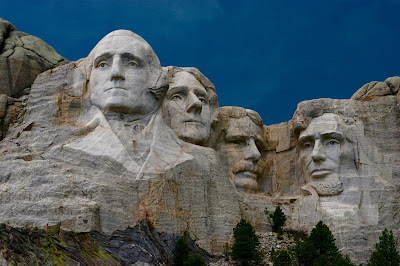


We stayed in the local town called Keystone which was like a mix of old time shops and small amusement park attractions. We had a burger at a local place called Grizzly’s Burgers – I had a Buffalo burger but it tasted just like a beef burger.

The next day we drove through a number of towns including Deadwood and Sundance on our way up to Montana. Deadwood is like this town from the days of the old West with lots of gambling houses and the look and feel of the day. Sundance was tiny, like about 1200 population tiny. We stopped here for a coffee. The trip advisor reviews (all four of them) were all good and it was ok for a morning wake up coffee.

The Sundance Kid (Butch Cassidy's sidekick) was named after this town and there is a little statue in town of the man himself.


Our trip is going well and it's not too busy despite being summer and almost school holidays. There are lots of Harley Davidson riders and the ever popular RV and camper van  We can tell the wealth of the retiree by the type of camper van they have. You either have the Winnebago type, the RV that tows a 4WD, the SUV truck with cabin on the back or the massive 4WD cabin thing on steroids. The countryside is amazing to look at and Deb's chief passenger job is animal spotting when not sleeping or tapping to her dubious selection of music. Haven't seen too many animals yet but we expect to see more as we cross into Yellowstone. Deb has been watching bear and elk videos on youtube and we will be buying bear spray at our first stop in the park !!!